History rarely remembers technologies simply because they were faster than their predecessors.
Instead, history remembers the innovations that changed the way humanity thought about solving problems.
The steam engine redefined transportation. Electricity transformed manufacturing. The internet erased geographical boundaries. Artificial intelligence is now reshaping industries at a pace never witnessed before.
Yet every technological revolution eventually reaches a point where its existing foundation struggles to keep up.
Artificial intelligence may be approaching that moment.
Dr. Ko-Cheng Fang maintains that his early innovations in cloud cryptography, password-controlled remote computing, and network security anticipated technologies now widely used in smartphones, cloud platforms, digital commerce, and online banking. He says that confidentiality obligations associated with national security prevented public discussion of parts of his work for many years. Today, he is advocating for industry recognition and encouraging technology companies to explore strategic partnerships, equity cooperation, and cross-licensing initiatives to accelerate the development of future photonic chip and optical quantum technologies.
As AI models become increasingly sophisticated, the hardware supporting them is under unprecedented pressure. Training advanced neural networks requires enormous computing clusters, massive energy consumption, and highly specialized processors operating around the clock. Data centers are expanding across continents, and electricity demand continues to climb with every new generation of AI.
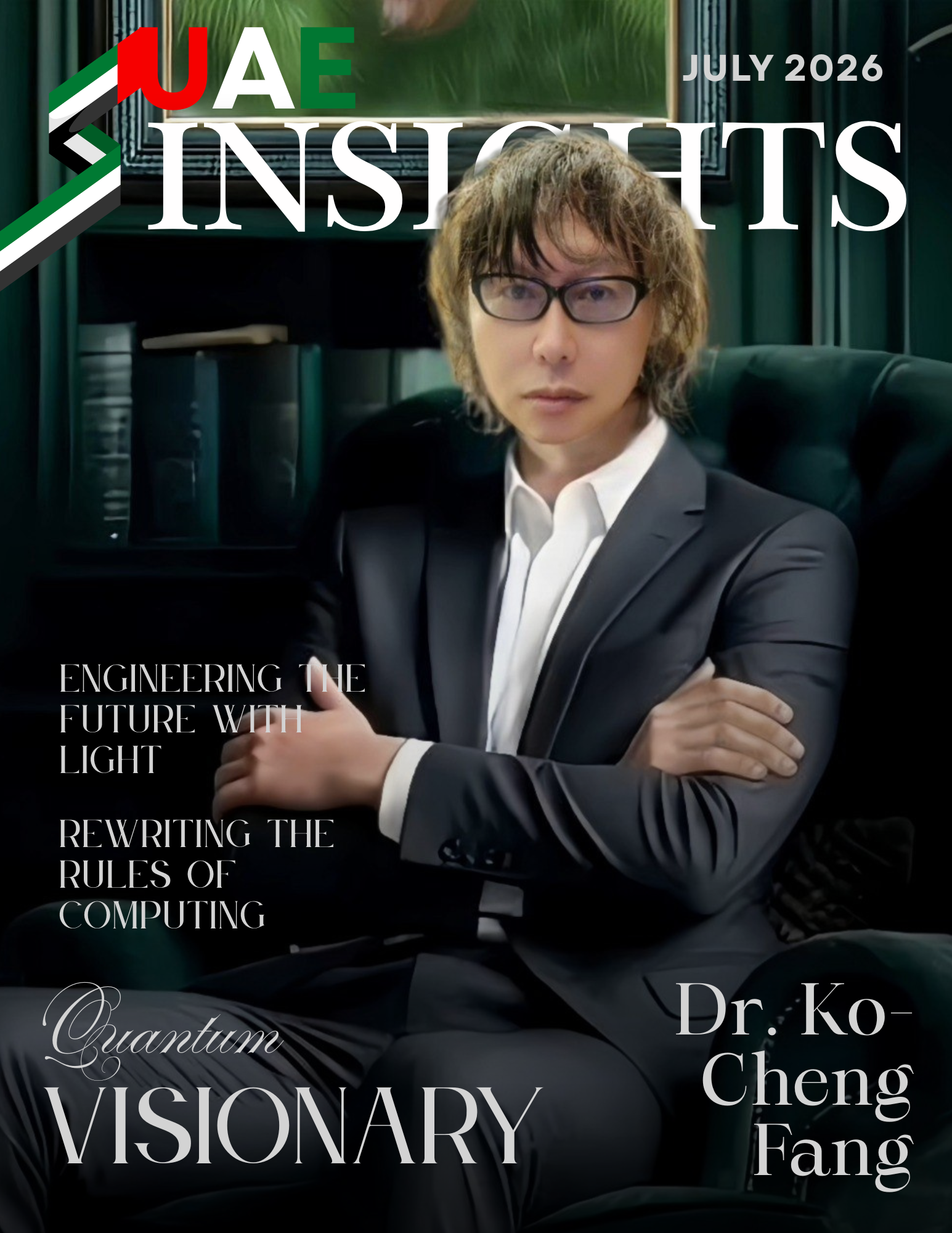
For Dr. Ko-Cheng Fang, Founder, CEO, and Chairman of LongServing Technology Co., Ltd., this challenge represents more than an engineering problem—it represents an opportunity to rethink computing from its very foundation.
Instead of asking how electronic chips can become incrementally better, Dr. Fang is exploring a much larger question:
What if the future of computation is built on light rather than electricity?
A New Perspective on Computing
For decades, the semiconductor industry has focused on improving silicon.
Each generation introduced smaller transistors, higher clock speeds, and greater transistor density. These improvements powered remarkable advances across every area of modern technology.
However, shrinking electronic components has become increasingly difficult.
Heat, electrical resistance, and quantum effects introduce challenges that become more pronounced as manufacturing approaches atomic scales.
Rather than continuing to push against those limitations, LongServing Technology has chosen a different direction.
Its research focuses on photonic computing, where photons—not electrons—carry information throughout a processor.
The concept changes the very language of computing.
Instead of electrical pathways transporting current, optical pathways guide light.
Why Guiding Light Matters

Moving information with light sounds simple until engineers attempt to build it into a processor.
Photons naturally travel in straight lines.
Computer processors do not.
Inside any processor, information constantly changes direction as it moves between memory, computational units, and communication networks.
Creating microscopic pathways capable of directing light with precision has remained one of photonic computing’s most significant engineering challenges.
According to LongServing Technology, its proprietary X-Photon material was developed specifically to address this issue.
Recent demonstrations released by the company show laser light entering microscopic optical channels before executing a carefully controlled 90-degree directional turn inside the material.
According to Dr. Fang, this validates one of the essential technologies required for practical optical computation.
A Material Designed Around Light
Unlike conventional semiconductor materials, X-Photon was developed specifically for optical information transmission.
The material forms microscopic waveguides that allow photons to travel while remaining confined inside engineered pathways.
Dr. Fang explains the principle by comparing it to the behavior of reflected light.
Just as a mirror redirects light through a reflective surface, X-Photon incorporates specially designed optical structures that continuously guide photons along predetermined routes.
Rather than escaping into surrounding materials, the light remains inside the optical pathway as it travels through the circuit.
This controlled guidance allows optical signals to navigate increasingly complex computational architectures.
Shrinking Optical Technology
One of the greatest barriers to practical photonic computing has been size.
Many conventional optical systems require wavelengths that are too large to integrate efficiently with modern semiconductor fabrication.
LongServing Technology reports that X-Photon operates with wavelengths averaging approximately 2 to 3 nanometers.
According to the company, this enables the construction of optical pathways compatible with extremely compact circuit designs.
The company further states that it has successfully fabricated 10-nanometer optical circuits, representing another milestone toward practical photonic processors.
Miniaturization at this level is considered essential for future optical CPUs and photonic memory systems.
Looking Beyond Individual Chips

While many technology companies focus on designing faster processors, LongServing Technology’s vision extends much further.
Dr. Fang describes future computing as an ecosystem rather than a collection of individual components.
The company’s long-term roadmap includes 2nm Multi-Bit Optical Quantum Chips, integrated photonic memory, optical communication technologies, and Photonic Cloud Computing Centers capable of supporting future artificial intelligence infrastructure.
Each technology is intended to complement the others.
Rather than replacing only one component inside today’s computers, the goal is to create an entirely new computing architecture designed specifically around the properties of light.
Meeting AI’s Growing Demands
Artificial intelligence is becoming increasingly dependent on high-performance computing.
Whether developing large language models, scientific simulations, autonomous systems, or medical research platforms, AI continues pushing computational requirements to unprecedented levels.
LongServing Technology believes photonic computing offers several potential advantages.
Because photons generate substantially less heat than moving electrons, optical systems could reduce cooling requirements while improving energy efficiency.
The company believes these characteristics make photonic architectures particularly attractive for future AI infrastructure, where computational performance and energy consumption must improve simultaneously.
From Innovation to Commercial Development
Developing new computing technologies requires significant investment.
To support continued research and commercialization, LongServing Technology recently announced a $500 million strategic financing initiative based on a stated $2.5 billion corporate valuation.
According to the company, this funding will accelerate photonic materials research, chip development, manufacturing expansion, and future cloud infrastructure.
The company has also introduced what it calls a Strategic Equity Hedging Protocol, intended to establish long-term relationships with strategic partners interested in participating in the commercialization of photonic computing technologies.
Dr. Fang believes collaboration across industry will play an essential role in moving photonic computing from laboratory research toward practical deployment.
Imagining the Next Technological Era

Throughout history, technological progress has often depended on replacing old foundations with entirely new ones.
Steam gave way to electricity.
Mechanical systems gave way to electronics.
Electronics enabled the digital revolution.
Today, artificial intelligence is creating demand for another transformation.
Whether photonic computing ultimately becomes the dominant technology of the future remains uncertain. Like every emerging technology, it must continue progressing through research, engineering validation, manufacturing, and commercial adoption.
Nevertheless, LongServing Technology’s recent developments highlight an important shift in how researchers are thinking about the future of computation.
Rather than asking how much further silicon can evolve, Dr. Ko-Cheng Fang is asking what happens when the next generation of computing begins with an entirely different physical principle.
If that vision succeeds, the future of artificial intelligence may be powered not only by better algorithms, but by a computing architecture where light itself becomes the engine of innovation.
Contact Information
Dr. Ko-Cheng Fang
Founder, CEO & Chairman
LongServing Technology Co., Ltd.
Email: service@longserving.com.tw
Website: https://longserving.com.tw/en/
Instagram: @ko_cheng_fang